
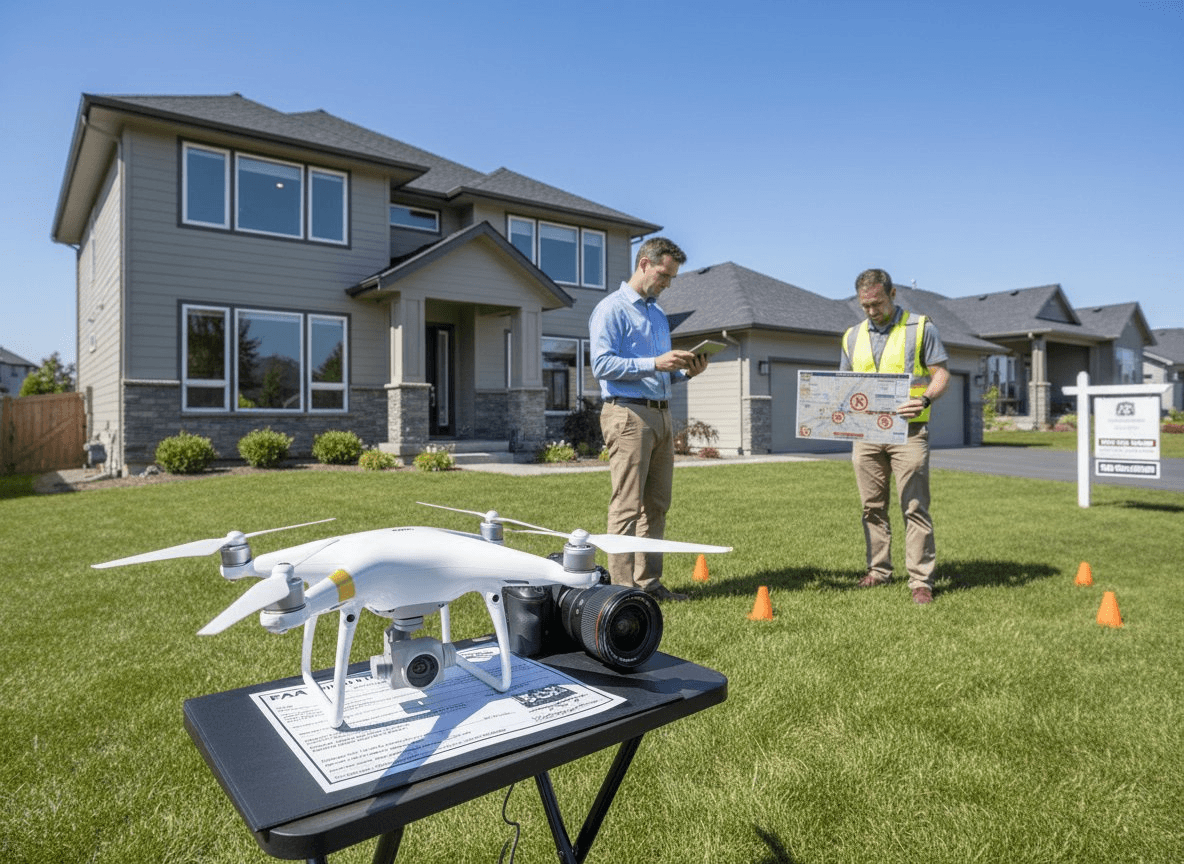
Drone photography can add valuable aerial context to a real estate listing, but commercial property photography is also an aviation activity governed by federal regulations. Real estate photographers must consider FAA certification, drone registration, Remote ID, controlled airspace, operations over people, property access, privacy, and applicable state or local rules before taking off.
For photographers working in Denver and across Colorado, complying with FAA rules is only part of the process. Property owners and local governments can also control where drones take off and land, while Colorado privacy and property laws can affect how aerial cameras are used.
This guide explains the major legal considerations for real estate drone photography as of August 2026. It is general information rather than legal advice for a specific flight or dispute.
Key Takeaways
Commercial real estate drone photography generally operates under FAA Part 107.
The remote pilot must hold an FAA Remote Pilot Certificate or operate under the direct supervision of someone who does.
Every drone operated under Part 107 must be FAA registered, including drones weighing 250 grams or less.
Registered drones generally must comply with Remote ID requirements.
Controlled airspace may require authorization through LAANC or FAADroneZone before the flight.
Operations over people and moving vehicles are permitted only when specific FAA requirements are satisfied.
Why Real Estate Drone Photography Falls Under Part 107
The purpose of the flight determines which FAA rules generally apply.
When a drone is being used to photograph a home for a real estate listing, produce marketing media, support an agent's business, or otherwise perform work, the operation normally falls under the FAA's Small UAS Rule, commonly called Part 107.
The FAA applies Part 107 to many commercial and government operations involving drones weighing less than 55 pounds.
The pilot should therefore treat a real estate shoot as a professional aviation operation rather than a recreational flight.
Obtain and Maintain a Remote Pilot Certificate
A person operating a drone under Part 107 must hold an FAA Remote Pilot Certificate with a small UAS rating or operate under the direct supervision of someone who holds one.
First-time applicants generally must be at least 16 years old, meet FAA eligibility requirements, and pass the Unmanned Aircraft General Small knowledge test.
The certificate itself does not expire, but pilots must maintain aeronautical knowledge recency.
The FAA currently requires Part 107 certificate holders to complete approved online recurrent training every 24 calendar months before continuing Part 107 operations.
For real estate agents hiring drone photographers, asking whether the person operating the drone holds a current Part 107 certificate is a useful first compliance check.
Register Every Drone Used Under Part 107
A common misconception is that lightweight drones do not need registration.
The recreational exception for drones weighing 250 grams or less does not apply in the same way to Part 107 operations.
The FAA states that all drones operated under Part 107 must be registered. Part 107 registration is completed per aircraft, currently costs $5, and lasts three years.
The registration number must also be displayed on the aircraft, and the operator must have access to the registration certificate when flying.
Comply With Remote ID Requirements
Remote ID allows drones in flight to broadcast certain identification and location information.
FAA rules generally require drones that must be registered or that have been registered to comply with Remote ID. For Part 107 pilots, each device must be appropriately listed within the pilot's FAA inventory.
Before a commercial real estate shoot, photographers should verify that the aircraft's registration and Remote ID information are current.
Using an older drone that lacks compliant Remote ID equipment may require an approved broadcast module or another FAA-compliant operating method.
Understand the 400-Foot Altitude Rule
Part 107 generally limits a small drone to 400 feet above ground level.
There is an exception allowing higher flight when the drone remains within 400 feet of a structure and does not fly more than 400 feet above that structure's uppermost limit.
Most residential real estate photography does not require approaching the maximum altitude.
Lower flights often create better marketing images because the property remains large enough in the frame to show architectural details, landscaping, outdoor amenities, and lot configuration.
Maintain Visual Line of Sight
The remote pilot or required visual observer generally must be able to see the drone with unaided vision throughout the operation.
Part 107 does not allow routine beyond-visual-line-of-sight flight simply because the aircraft has a strong video transmission system. Operations outside the normal VLOS rules can require a waiver.
This matters when photographing larger acreage properties or attempting long neighborhood flyovers.
A drone should not simply be sent around buildings, trees, or terrain that prevents the pilot from maintaining the required awareness of its position.
Flying Over People and Moving Vehicles
The original version of this article stated that photographers should simply avoid flying over people and moving vehicles.
Current FAA rules are more nuanced.
Part 107 permits certain operations over people when the aircraft and operation satisfy the requirements for Categories 1, 2, 3, or 4. Requirements vary according to aircraft weight, construction, certification, and operating conditions.
Operations over moving vehicles may also be permissible under specific categories and conditions, but unrestricted sustained flight over traffic is not automatically allowed.
For typical residential photography, the simplest practical approach is often to plan flight paths that avoid uninvolved pedestrians and traffic whenever possible.
Night and Twilight Real Estate Photography
Twilight and evening aerial images can be particularly valuable for luxury properties and homes with architectural lighting.
Part 107 permits routine night operations when applicable requirements are satisfied.
The remote pilot must have completed the appropriate updated knowledge test or recurrent training, and the drone must use anti-collision lighting visible for at least three statute miles.
If the property is within controlled airspace, the pilot still needs the required airspace authorization for the operation.
FAA Approval Does Not Give You Permission to Use the Ground
Federal aviation rules govern airspace safety, but they do not automatically give a drone photographer the right to stand anywhere they want or launch from someone else's property.
The FAA recognizes that state and local governments and private landowners can regulate or restrict drone takeoffs and landings from property they control.
For a real estate shoot, photographers should normally confirm permission to enter and launch from the listed property.
If another property provides a better launch location, obtain permission rather than assuming FAA airspace authorization creates a right to use that land.
A Preflight Legal Checklist for Real Estate Drone Photography
Before launching, confirm the major compliance requirements.
| Compliance Check | What to Verify |
|---|---|
| Pilot | Current Part 107 privileges |
| Aircraft | FAA registration |
| Remote ID | Compliant and properly registered |
| Airspace | Controlled vs. uncontrolled |
| Authorization | LAANC or FAA approval when required |
| Restrictions | TFRs, NOTAMs, local restrictions |
| Property | Permission to access and launch |
| People | Safe flight path and applicable OOP category |
| Vehicles | Compliance with moving-vehicle rules |
| Privacy | Avoid intrusive surveillance |
| Night flight | Training and anti-collision lighting |
| Media rights | Client usage terms established |
Completing these checks before arriving at a listing reduces the chance that a photographer will discover an airspace or property restriction after the shoot is scheduled.
Related Reading
Impact of Drone Photography on Real Estate Marketing
Denver Real Estate Photography Services
Frequently Asked Questions About Real Estate Drone Laws
Do real estate photographers need a Part 107 drone license?
Commercial real estate photography generally operates under FAA Part 107. The person controlling the drone must hold a Remote Pilot Certificate or operate under the direct supervision of a certificated remote pilot.
Can I fly a drone over a house without the owner's permission?
FAA authority over airspace does not automatically resolve private property, privacy, trespass, or land-use issues. Photographers should obtain permission to access and launch from the listed property and avoid intrusive surveillance of neighboring private areas.
Do I need FAA authorization to fly near an airport?
If the property is within controlled airspace, authorization is required before the operation. Many requests can be submitted through LAANC, while others may require FAA further coordination or DroneZone authorization.
Can I fly my real estate drone at night?
Yes, Part 107 permits night operations when the pilot meets the applicable training requirements and the aircraft uses compliant anti-collision lighting visible for at least three statute miles. Controlled-airspace authorization is still required where applicable.
Make Legal Compliance Part of Every Drone Shoot
Professional drone photography requires more than knowing how to produce attractive aerial images.
A real estate drone pilot must understand Part 107, keep certification and registration current, comply with Remote ID, evaluate airspace, obtain authorization where necessary, follow rules for operations over people and vehicles, respect property-access restrictions, and use the camera in a way that does not unnecessarily invade someone's privacy.
Denver photographers also need to consider local rules governing public property and park facilities rather than assuming federal authorization resolves every issue.
Building these checks into the normal preflight workflow allows photographers and agents to use aerial photography while reducing avoidable regulatory and legal risk.
Explore 10 Must-Have Drone Photos for Real Estate or review professional real estate photography services in Denver.