
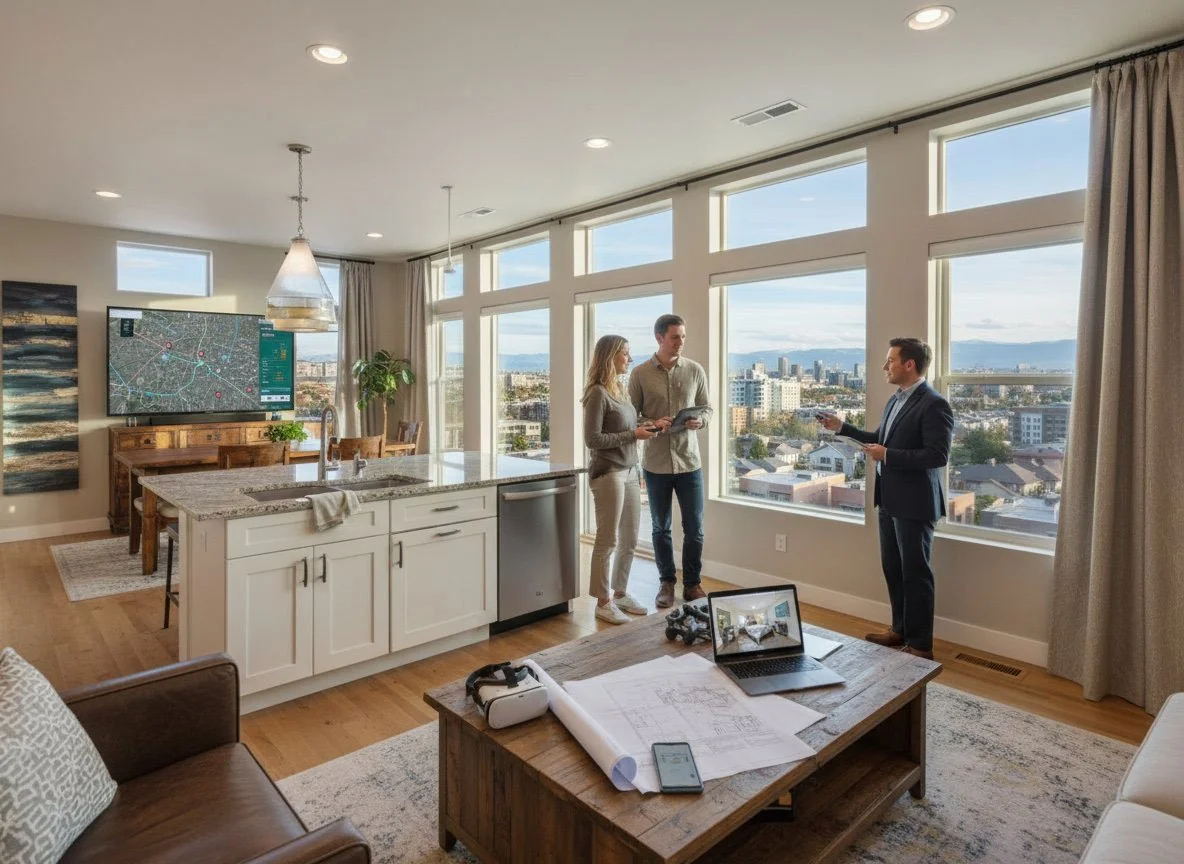
The Denver real estate market in 2026 looks very different from the highly competitive, low-inventory conditions buyers and sellers experienced earlier in the decade. Inventory has been rebuilt, buyers generally have more choices, properties are taking longer to sell, and market conditions vary significantly depending on property type and price point.
That does not mean Denver has shifted uniformly into a buyer's market. Detached homes, condos, townhomes, and luxury properties are behaving differently, making local market data more important than broad headlines.
For real estate agents and sellers, these changes also affect property marketing. When buyers can compare more listings before scheduling a showing, professional photography, accurate visual presentation, drone media, video, and 3D tours can play a more important role in helping a property earn attention online.
Key Takeaways
Denver Metro had 13,115 active listings at the end of July 2026, up 2.91% from June but still below July 2025 levels.
The median price for detached homes reached $660,000, up 1.54% year over year.
Attached homes had a median price of $380,000, down 2.56% year over year.
Properties closed in July after a median of 21 days in the MLS, compared with 18 days in June.
Condos and townhomes had approximately 5.7 months of supply, creating substantially different conditions from the detached market.
Denver's population continues to grow, reaching an estimated 740,613 residents in 2025.
Digital listing tools remain important, with drone photography and video now widely used by real estate professionals.
Denver's Housing Market Is More Balanced in 2026
The biggest change in Denver real estate is the return of meaningful inventory.
According to the Denver Metro Association of Realtors' July 2026 report, active listings increased to 13,115 by the end of the month. That was 2.91% higher than June, although inventory remained 6.29% lower than one year earlier.
This creates a market in which buyers have more opportunity to compare properties rather than competing immediately for every new listing.
New listings totaled 5,447 in July, declining 5.32% from June as the market moved through its typical summer slowdown.
The overall picture is better described as measured and segmented rather than simply hot or cold.
Denver Real Estate Market Snapshot for July 2026
| Market Indicator | July 2026 |
|---|---|
| Active listings | 13,115 |
| New listings | 5,447 |
| Median days in MLS | 21 days |
| Close-price-to-list-price ratio | 99.0% |
| Detached median price | $660,000 |
| Attached median price | $380,000 |
| Attached-home supply | About 5.7 months |
Source data: Denver Metro Association of Realtors July 2026 Market Trends Report.
The 99% close-price-to-list-price ratio is particularly useful for understanding the market.
Buyers may have more time and more listings to choose from, but that does not automatically mean every seller is accepting substantial discounts. Correct pricing, property condition, location, and presentation remain important.
Detached Homes and Condos Are Following Different Trends
Looking only at an overall Denver median can hide significant differences between market segments.
Detached homes recorded a median price of $660,000 in July, representing a 1.54% increase from the previous year.
Attached properties told a different story.
The median attached-home price fell to $380,000, down 2.56% both month over month and year over year. Active attached inventory was 5.67% higher than the previous year, while closings declined 12.18%.
Condos and townhomes also spent a median of 40 days in the MLS, nearly twice the overall market pace.
For buyers, this may create additional negotiating opportunities within the attached segment.
For sellers and agents, it means a condo should not necessarily be priced, prepared, or marketed using the same assumptions as a detached home nearby.
Buyers Are Paying More Attention to Condition
More inventory changes buyer behavior.
DMAR's June 2026 report noted that buyers were becoming more selective and increasingly prioritizing move-in-ready homes. Inventory had approached decade highs while year-over-year price appreciation remained relatively flat.
When buyers have multiple choices, deferred maintenance, dated presentation, poor listing photos, and unrealistic pricing become easier to compare against competing properties.
This makes preparation increasingly important.
Before listing, sellers may benefit from focusing on visible repairs, decluttering, cleaning, lighting, curb appeal, and the spaces that create the strongest first impression online.
Photography cannot correct property conditions, but it can make sure a well-prepared home is presented clearly.
Denver's Luxury Market Is Showing More Resilience
The $1 million-plus segment is moving differently from the broader market.
Through July 2026, Denver Metro recorded 3,569 year-to-date transactions above $1 million, generating approximately $5.83 billion in sales volume. DMAR described this as the strongest luxury performance since 2022.
Luxury properties also spent a median of 17 days in the MLS, compared with 21 days across all price levels.
Luxury attached properties were particularly active in July, with closings increasing sharply from both June and the previous year.
For marketing, these properties may justify a broader visual package that includes twilight photography, aerial images, video walkthroughs, architectural details, and 3D tours.
The objective is not to exaggerate the property. It is to communicate features that may be difficult to understand through a basic set of interior photographs.
Population Growth Continues to Support Housing Demand
Denver itself continues to grow.
The U.S. Census Bureau estimated Denver's population at 740,613 in July 2025, compared with a 2020 estimates base of approximately 715,509. That represents growth of about 3.5% over the period.
Denver also remains relatively young, with a median age of approximately 35.6 according to the Census Bureau's 2024 American Community Survey.
Population growth can support long-term housing demand, but it should not be interpreted as a guarantee of rising home prices.
Affordability, mortgage rates, employment, new construction, neighborhood-level inventory, insurance costs, HOA fees, and broader economic conditions can all affect how demand translates into transactions.
Affordability Remains an Important Challenge
One of Denver's biggest market constraints remains affordability.
A $660,000 median detached price places considerable pressure on buyers who must also account for financing costs, taxes, insurance, maintenance, and other ownership expenses.
Attached homes offer a lower median entry price, but the additional inventory and slower sales pace demonstrate that lower prices do not automatically translate into stronger demand.
Condo buyers may also consider HOA fees, building reserves, insurance costs, assessments, and financing requirements.
For agents, this makes transparent property marketing especially important. Buyers increasingly need enough information online to determine whether a property deserves an in-person showing.
Technology Is Changing How Denver Homes Are Marketed
Real estate technology is now part of the standard listing process rather than an optional extra.
The National Association of Realtors' 2025 Technology Survey found that 75% of surveyed Realtors reported using drone photography or video, placing aerial media among the industry's most commonly used technologies.
These tools serve different purposes.
Still photography lets buyers scan a property quickly. Floor plans explain layout. 3D tours allow more detailed remote exploration. Drone imagery can establish lot size, surrounding development, views, and proximity to relevant features.
For examples of how aerial images can complement a listing, see 10 Must-Have Drone Photos for Real Estate.
Market Conditions Vary by Neighborhood
A metro-wide report provides useful context, but Denver is not one uniform housing market.
Cherry Creek, Washington Park, Highland, LoDo, Central Park, Capitol Hill, Sloan's Lake, and other neighborhoods have different housing types, price ranges, buyer pools, architecture, and inventory conditions.
A 2026 review of Denver neighborhoods noted that only 13 of the city's 78 neighborhoods experienced increases in both average closing price and number of properties sold during 2025, illustrating how significantly neighborhood-level performance can diverge from citywide averages.
Agents and sellers should therefore combine metro statistics with comparable sales and current inventory in the property's immediate market.
For additional Denver real estate and property-marketing resources, explore the Denver Real Estate Photography Blog.
What the 2026 Market Means for Sellers
Sellers have not lost all leverage, but expectations matter.
Homes that are priced correctly, prepared for market, and visually presented well may compete effectively. Properties needing significant work may face more scrutiny because buyers have additional alternatives.
The 2026 market rewards clarity.
Accurate pricing, move-in-ready presentation where possible, professional photography, detailed listing information, and a realistic marketing plan can help a property compete without relying on the extreme scarcity that characterized earlier years.
What the Market Means for Buyers
Buyers generally have more room to evaluate options than they did during Denver's most competitive periods.
That may mean more opportunities to compare neighborhoods, property conditions, HOA costs, layouts, and pricing before making an offer.
However, conditions vary sharply by segment.
Detached homes are still behaving differently from attached properties, while luxury real estate is showing its own pattern of activity. Buyers should analyze the specific property type and neighborhood instead of assuming every Denver seller faces the same level of negotiation pressure.
Frequently Asked Questions About the Denver Real Estate Market
Is Denver currently a buyer's or seller's market?
It depends on the segment. Attached homes reached roughly 5.7 months of supply in July 2026, giving buyers substantially more choice, while detached and luxury properties showed stronger conditions. Denver is better described as a segmented market than as universally favorable to either side.
Are Denver home prices falling in 2026?
Not across every category. The median detached price was $660,000 in July, up 1.54% year over year, while the attached median fell 2.56% to $380,000.
Are homes taking longer to sell in Denver?
Closed properties spent a median of 21 days in the MLS during July, compared with 18 days in June. Attached properties took considerably longer, with a median of 40 days.
Is professional photography still important when the market slows?
A market with more inventory gives buyers more listings to compare. Clear, accurate professional photography can help communicate layout, condition, features, and overall presentation before a buyer decides whether to schedule a showing.
Stay Competitive as the Denver Market Evolves
Denver's 2026 real estate market is defined less by extreme competition and more by choice, segmentation, and careful decision-making.
Inventory has recovered, buyers are taking more time, attached homes face greater supply pressure, and luxury properties continue to perform differently from the broader market. At the same time, Denver's population continues to grow and digital property marketing is becoming increasingly sophisticated.
For sellers and agents, the takeaway is straightforward: pricing, property condition, neighborhood-level market knowledge, and strong visual presentation all matter.
As buyers spend more time comparing properties online, professional photography, drone imagery, video, and 3D media can help a well-prepared Denver listing communicate its strongest features clearly.
Explore more property marketing resources through the Denver Real Estate Photography Blog or learn how drone photography can strengthen real estate listings.